Print
friendly. Use browser's print function to print this page.
Recent
Paintings;
"Blood and Perfume" 1996 exhibit;
Blood and Perfume, written by Michael Rooks
The
unifying theme in this group of paintings is the sense of smell. Departing
from a traditional allegorical depiction of the senses such as in Dutch
and Flemish painting of the 17th-century, or in earlier Italian and Spanish
painting such as Caravaggio’s Bacchus or in Jusepe de Ribera’s
series The Senses, Barnes avoids conventional still-lifes of aromatics
or tableaus involving the nose. Barnes’s paintings are about the
sorts of images formed in personal recollections deeply embedded in the
subconscious, and evoked by certain smells. To this end, Barnes even mixed
perfume with his paint to facilitate his own evocation of imagery in the
studio. Recollections of past experiences, romantic, banal or terrible,
are often triggered by smells both good and bad. The potential combinations
of these contradictory elements and the stream-of-conscious associations
between and among sensory information, visual and olfactory (as well as
aural, tactile and gustatory), inspired this new group of paintings.
Barnes
has taken the fragrance of perfume as a point of departure not only for
its powerful memory inducing effects but also because of the nature of
its composition: perfumes smell spicy, floral, herbal, mossy or smoky,
however these pleasant odors are often the result of combinations of pungent
or rancid smelling ingredients such as musk or ambergris. Ambergris is
a substance found in the intestine of sperm whales and thought to form
as a collection of feces around the indigestible parts of squid. It is
significant that the manufacture of perfume is in this way like alchemy,
for Barnes is interested in the transformation of his common or abject
painting materials into something extraordinary, rare and evasive like
perfume.
Throughout
his career, Barnes has always considered the causes and processes of memory
in relation to image making. Images produced in memory are set apart from
reality and their original significance, becoming in a way their own realities.
Remembrance and recollection of youth past was the subject of Barnes’s
important early painting Interior (1956) signaled by a visual allusion
to Moby Dick. In Melville’s novel, the character Stubbs often soliloquizes
about the past while smoking his pipe -- smoke stirs his memory and feeds
his monologues. Analogously, in this new work on view, perfume literally
translated from Latin means through smoke.
Barnes
continues to take up subjects that are literary or artistic. In The Odor
of Sanctity Barnes refers to a 5th -century inscription at the Cologne
Cathedral which provides the only history of St. Ursula and the “eleven
thousand” virgins that were buried with her. An ancient story related
that upon uncovering the burial ground an awful stench filled the air.
A large jawbone of a horse was discovered among the remains and, extracted,
produced a beautiful fragrance like that of flowers: the pleasing odor
being proof of the divine nature of the remains to be questioned only
by the impious. Here, the masking property of the jawbone’s odor
is of interest as fragrances, conversely, are manufactured to mask unpleasant
odors. A thematic undercurrent that connects the Blood and Perfume paintings
is the nature of truth and deception. In The Odor of Sanctity, “truth”
is revealed by the removal of the abject jawbone, and symbolized by the
sweet smelling perfume that rises from the remains: as suggested in Blood
and Perfume, blood is the physical component that sinks into the earth
while perfume is the ethereal which ascends into the heavens. Echoing
Melville, Barnes reflects on “how that we are sown in dishonor, but
raised in glory,” and “the strange fact that of all things of
ill-savor, Cologne-water, in its rudimental [sic] manufacturing stages,
is the worst.”
In
Belle Haleine, Barnes pays homage to Marcel Duchamp whom he had known
very well in the late 1950’s until the time of Duchamp’s death
in 1968. Belle Haleine is borrowed from the title of Duchamp’s assisted
ready-made, Belle Haleine, Eau de Violette, which translated means “beautiful
breath, veil water.” The underlying contradiction in Duchamp’s
pun and the nature of truth and beauty are some of the themes that are
interwoven in Belle Haleine. Barnes quotes Duchamp in the painting by
including the image of Rose Sélavy, Duchamp’s female alter-ego,
as well as Duchamp’s “ectoplasmic thought cloud” from The
Large Glass which has appeared and reappeared in Barnes’s paintings
since the early 1960’s.
Barnes’s perfume paintings offer viewers an opportunity to immerse themselves into their sumptuous surfaces or mysterious worlds, experiencing them synesthetically or sensually—closer to that way in which the artist himself experiences the act of painting. Barnes has always explained painting as a sensual experience, comparing paint and oil to body fluids such as blood, saliva and semen. It is appropriate that Barnes has taken up perhaps the least understood of the senses to paint about. For him, art is about how “we love not knowing -- it is mystery that conditions life.”
|
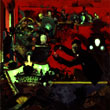
Guerlin |
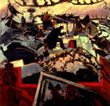
Ursula
click on paintings to enlarge |
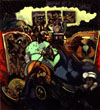
Belle
Haleine Eau de Violette |